Q: Why do you focus on FPGA?
A: We think that FPGA prototypes are an opportunity for Chip, IP and FPGA system design.
When you design a chip, an FPGA or an IP, you have to make sure that it works according to the specs (that is verification) and according to the intended use (that is validation). In addition, software and firmware updates will require successive regression test runs.
When used as prototypes, FPGAs are one of the closest technologies to ASIC gates, and can be used as a reasonably good model of what the future chip will be. When they are used as target technology, then they can be mobilized for these tasks right away. Finally, they provide a very good platform for IP behaviour testing.
Because they are largely accessible and affordable, we believe that FPGA prototypes must be mobilized in the design flow.
Q: Why FPGAs and not simulation or emulation?
A: FPGAs are no replacement for simulation or emulation!
How they are different:
- Simulation: a must fordesign and verification
- Emulation: accelerate simulation to tackle complexity
- FPGA prototypes: execute very large cycle numbers and allow software development
We think that improving FPGA prototyping is key to increasing its usage.
Emulation is hardly accessible to many and has its own drawbacks (low speed, cost).
FPGA prototyping is insufficiently leveraged, yet it is broadly available.
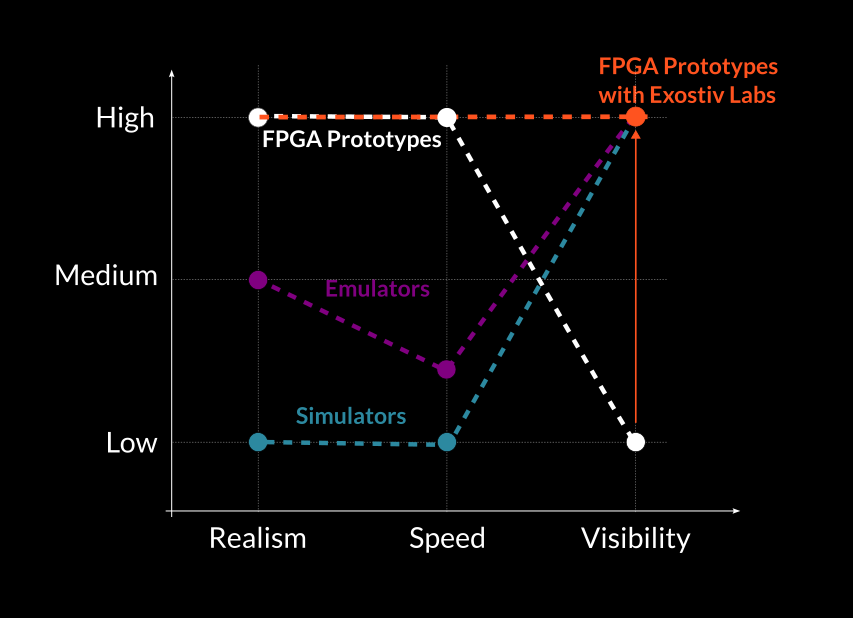
FPGA protototypes are the only platforms that run near or at system speed and can be placed in a realistic environment where you do not have to slow down what’s at the periphery. Unlike simulators and emulators, FPGA prototypes allow running realistic numbers of cycles before production.
Q : What does Exostiv Labs bring to FPGA prototyping?
A: Visibility.
FPGAs score high for prototyping speed and realism but usually lag behind for visibility.
Exostiv Labs tools let you look massively inside FPGA prototypes at speed of operation, with minimal impact on FPGA resources.
Q: What difference does it make for me?
A: Exostiv changes everything.
By providing unmatched FPGA capture capability, you can now efficiently leverage FPGA prototyping and analyze significant data from inside FPGAs.