
Your prototype is in a lab. Your team is not.
Distributed engineering teams should not be blocked by physical access to a single board.
The scenario you recognize
Your FPGA prototype is set up in one location — a lab, a rack, a test bench. Your verification engineers are in multiple offices, or working remotely, or split across time zones. Every debug session requires either physical presence or a slow, frustrating workaround: VPN into a remote desktop, screen sharing a waveform viewer, waiting for someone else to finish with the board.
The prototype is a shared resource. Access to it is the bottleneck.
Why this matters more now
Hardware prototypes are expensive and complex to set up. Replicating them for every engineer is not realistic. But the alternative — serializing access to a single setup — destroys verification throughput. An engineer waiting for board access is an engineer not debugging.
Post-2020 engineering teams are permanently distributed in ways that were not anticipated when most debug tools were designed. The tools have not caught up.
What Exostiv does differently
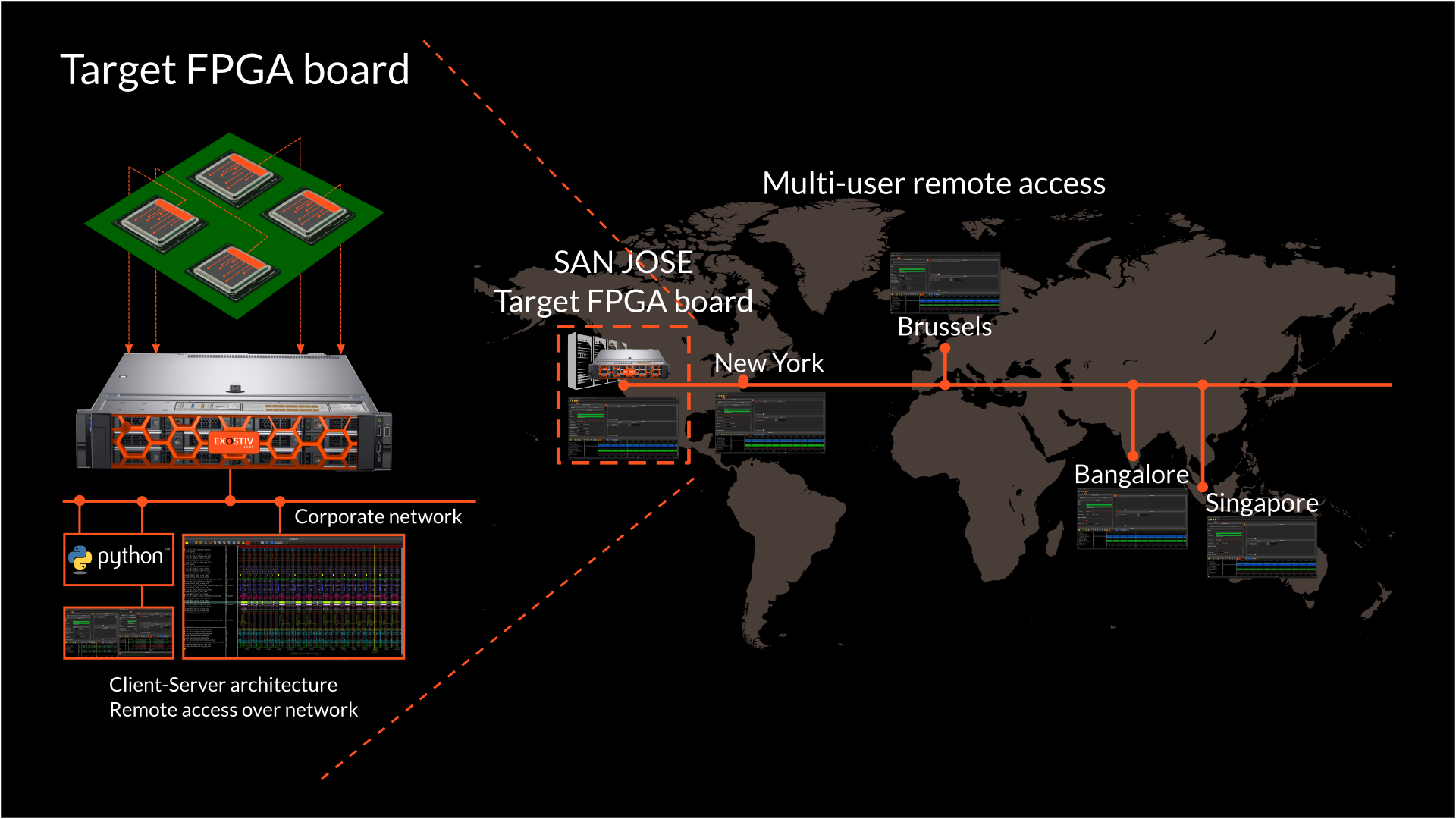
Exostiv Blade is a network appliance — not a bench instrument. It connects to your FPGA prototype and exposes it over the network. Multiple engineers, in multiple locations, can access captures simultaneously. Waveform databases are stored centrally and accessible remotely. Python automation allows captures to be triggered, retrieved, and processed without anyone physically present at the board.
The prototype stays in one place. The team works from anywhere.
The future direction
Remote access to captures is the foundation for the next step: automated triage. When captures are centrally stored and programmatically accessible, LLM-assisted analysis of captured traces becomes a natural extension — reducing the human time required to identify the originating event from hours to minutes.
See it on your board – Request a demo.